
Game Character Name Generator
https://gamenamegen.site- Next.js
- Cloudflare AI-workers
- Tailwind CSS
- TypeScript
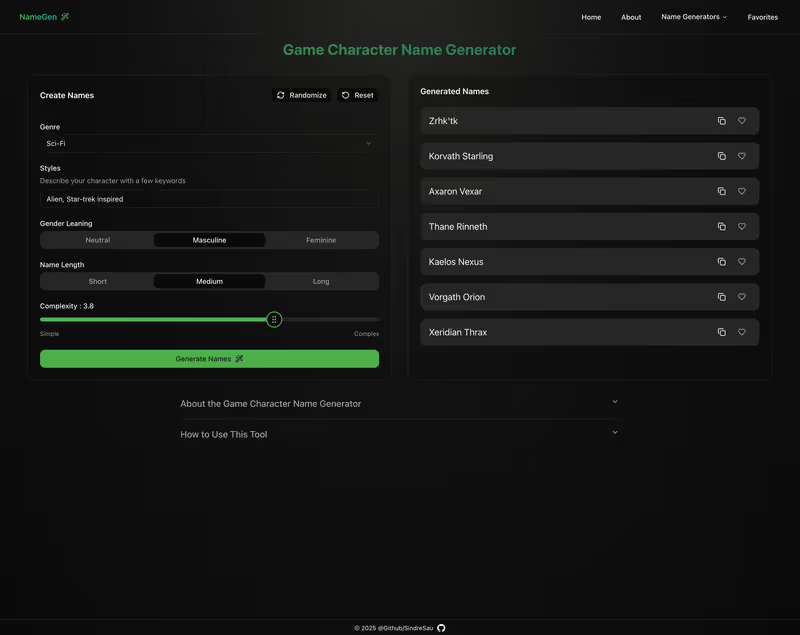
A web application powered by AI that helps users generate unique names for game characters. Originally built as a project to explore Nuxt and Hono, it was later rebuilt using Next.js and Cloudflare AI Workers. The aim was to create a fully AI-driven app that remains completely free to use by leveraging cost-free tools for both AI processing and web hosting.
LLM-Driven Name Generation
At its heart, the application uses Large Language Models to produce character names. This allows for a vast range of creative and contextually relevant suggestions. User inputs from the form (genre, style, complexity) are sent to the backend via Next.js Server Actions. These actions then construct a detailed prompt and query an LLM to generate a list of names.
Robust LLM Provider Fallback System
To ensure high availability and resilience, the system incorporates a fallback mechanism between two LLM providers (e.g., Cloudflare and Gemini). If the primary provider fails or returns an unsatisfactory response, the system automatically attempts the request with the secondary provider. The Server Action responsible for LLM communication first calls the primary API. If this call encounters an error or doesn't yield results, it transparently retries with the configured backup API, enhancing the reliability of name generation.
Modern and Responsive Frontend
The user interface is built with Next.js 15 and React, utilizing Tailwind CSS and pre-built shadcn/ui components for a clean, modern, and responsive design. Client components, marked with 'use client', manage the user interaction. Forms are built using react-hook-form for efficient state management and zod for schema-based validation, ensuring data integrity. User feedback is provided through sonner toast notifications, and subtle animations are implemented using a custom <FadeInSection> component for an enhanced user experience.
Efficient Backend with Next.js Server Actions
The application leverages Next.js Server Actions to handle backend logic, such as LLM API calls. This approach simplifies the full-stack development process by allowing server-side code to be co-located and easily invoked from client components. When a user submits the form, a Server Action (defined in a .server.ts file) is invoked. This function executes on the server, performs the necessary operations (like calling the LLM APIs), and returns a structured response ({ success: boolean, message: string, names: string[] }) to the client.
Well-Defined Structure and Type Safety
The codebase is organized into logical directories for components (ui, general, form-generator), application routes (app), Server Actions (actions), React hooks (hooks), and TypeScript types (types). This modular structure, combined with consistent naming conventions and the use of TypeScript throughout, promotes maintainability, scalability, and developer productivity by ensuring type safety.
The Generation Workflow
The process from user input to name generation is streamlined:
- User Configuration: The user selects their desired parameters (genre, style, complexity) via the form.
- Client-Side Validation: react-hook-form and zod validate the inputs on the client side.
- Server Action Invocation: Upon successful validation and submission, the relevant Server Action is called with the user's parameters.
- LLM Processing: The Server Action prepares a prompt and communicates with the LLM services, utilizing the fallback mechanism if needed.
- Response Delivery: The LLM-generated names are returned to the Server Action, which then formats the response and sends it back to the client.
- Displaying Results: The client component receives the names and displays them to the user, accompanied by a status notification.